
Are We Preparing Students to Lead or Just to Follow? Imagine a world where education is a lifelong journey of innovation and problem-solving, not just exams and grades. The future of education must move beyond rote learning to foster curiosity, creativity, and critical thinking. Are we shaping future leaders or just training students to follow instructions? By embracing a skills-focused approach, we can prepare learners to thrive in an ever-evolving world.
The Problem: An Education System Stuck in the Past
Many traditional education systems still prioritize rote memorization and exam performance over practical application and real-world problem-solving. This creates several challenges:
- Lack of Practical Application – Students struggle to apply what they learn outside the classroom, seeing knowledge as abstract rather than functional.
- Limited Critical Thinking – The emphasis on standardized testing stifles creativity and problem-solving, producing passive learners rather than active thinkers.
- Narrow Vision – Students graduate without awareness of industry trends, technological advancements, or societal needs, leaving them unprepared for future challenges.
- Declining Social Responsibility – With an overwhelming focus on academic performance, moral values and social responsibility often take a backseat.
- A ‘Robot’ Mindset – Many students operate like programmed machines, absorbing information without questioning or analyzing its relevance to real-world challenges.
Lessons from Around the World: Real-World Examples
Finland: Personalized Learning for the Future of Education
Finland’s education system consistently ranks among the best, not due to an obsession with grades, but because of its emphasis on student autonomy, personalized learning, and real-world problem-solving. Schools allow students to explore their interests while teachers act as mentors rather than mere lecturers. Finland’s model proves that when students are encouraged to take ownership of their learning, they develop a love for knowledge that lasts a lifetime.
High Tech High (USA): The Power of Project-Based Learning
At High Tech High in California, students don’t just memorize facts—they work on hands-on, interdisciplinary projects that solve real-world problems. For example, students have designed energy-efficient homes, created documentaries on social justice, and developed sustainable urban solutions. By integrating project-based learning (PBL), students not only grasp theoretical concepts but also develop critical thinking and leadership skills.
Riverside School (India): Cultivating Socially Responsible Leaders
Riverside School in India prioritizes compassion-driven learning. Instead of traditional classroom lectures, students engage in community-based projects, such as working with underprivileged groups or leading environmental initiatives. This approach instills a deep sense of empathy, social responsibility, and leadership, proving that education should create changemakers, not just test-takers.
The Industrial Revolution: A Historical Lesson
During the Industrial Revolution, education was designed to produce factory workers who followed instructions without question. This model, while effective for its time, is outdated in today’s world, where adaptability and innovation are key. The historical reliance on standardized methods should remind us that education systems must evolve to meet the demands of the era.
A Scientific Perspective: Neuroplasticity
Research in neuroscience highlights the concept of neuroplasticity—the brain’s ability to adapt and grow throughout life. This proves that learning isn’t confined to childhood or formal education. By fostering a growth mindset, we can empower students to continue learning and evolving long after they leave the classroom.“Live as if you were to die tomorrow. Learn as if you were to live forever.” — Mahatma Gandhi
Solutions: Transforming Classrooms into Innovation Hubs
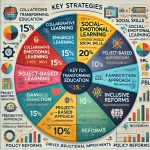
Personalized Learning Paths
Recognizing that every student has unique strengths and learning styles is key. Summit Public Schools (USA) uses a personalized learning platform that allows students to learn at their own pace, with mentorship and adaptive content tailored to individual needs.“Everyone is a genius. But if you judge a fish by its ability to climb a tree, it will live its whole life believing that it is stupid.” — Albert Einstein
Encouraging Project-Based Learning (PBL)
Instead of exams dictating success, students should solve real-world problems through hands-on projects. Schools like High Tech High have successfully implemented PBL, proving that students learn better when they can apply knowledge to tangible situations.“Tell me and I forget. Teach me and I remember. Involve me and I learn.” — Benjamin Franklin
Promoting Moral and Social Education
Integrating ethics, leadership, and community service into the curriculum helps nurture responsible citizens. Riverside School (India) excels in this area by ensuring students engage in meaningful social initiatives, fostering empathy and a sense of responsibility.
Focusing on Future-Ready Skills
Education should prepare students for the future, not the past. The future of education lies in equipping students with adaptive skills that meet the evolving demands of the modern world. Finland’s national curriculum is a prime example, emphasizing 21st-century competencies such as coding, entrepreneurship, and problem-solving. By integrating both technical expertise and soft skills, students graduate prepared for real-world challenges.
As Alvin Toffler wisely stated, “The illiterate of the 21st century will not be those who cannot read and write, but those who cannot learn, unlearn, and relearn.” The future of education must embrace continuous learning, adaptability, and innovation to ensure students thrive in an ever-changing landscape.
Teachers Training for Modern Challenges
Teachers must evolve with the times. Singapore invests heavily in teacher training, equipping educators with the latest tools and methodologies to bridge the gap between academia and industry needs.
Celebrating Effort Over Outcomes
Students should be encouraged to value the learning process over grades. Montessori schools use self-assessment and observational feedback rather than standardized testing to motivate students intrinsically.
Conclusion: The Future of Education
The world is changing rapidly, and education must evolve with it. By shifting from a grade-centric to a growth-centric model, we can cultivate curious, independent, and socially responsible individuals who are prepared for real-world challenges. As Albert Einstein said, “Education is not the learning of facts, but the training of the mind to think.” Let’s move beyond the confines of exams and grades to foster a culture of lifelong learning, innovation, and change-making. Only then can we truly prepare our students to lead—not just follow.
References
- Sahlberg, P. (2011). Finnish Lessons: What Can the World Learn from Educational Change in Finland?
- Dweck, C. S. (2006). Mindset: The New Psychology of Success.
- UNESCO (2023). The Future of Education: Perspectives on Global Trends.
- Research on PBL from High Tech High‘s official reports.
- Case studies on Montessori education and its effectiveness.
- Studies on teacher training models in Singapore.
- The Journal of Neuroscience research on neuroplasticity.